
Blog · Commercial Roofing
What Is TPO Roofing? A Flat Roof Guide for New Mexico Property Owners
TPO is the default membrane on flat roofs across southern New Mexico. Here is what it is made of, how long it really lasts in high-UV desert heat, and how it compares with EPDM and PVC.
Contents
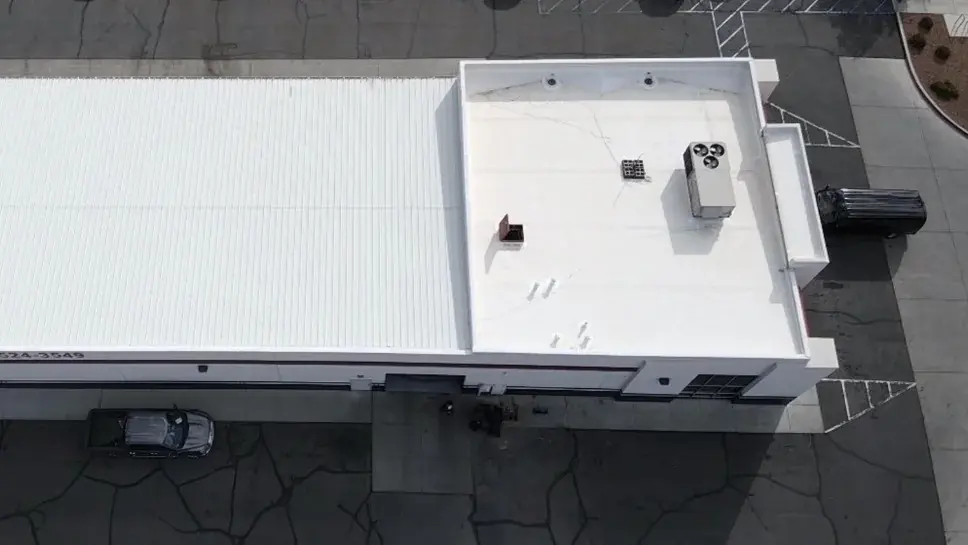
If you own a flat-roofed home or commercial building in Las Cruces, you've probably been quoted TPO at some point. It shows up on nearly every flat roof estimate, and it's become the default membrane for strip malls, warehouses, offices and a growing number of Pueblo-style homes across southern New Mexico.
And yet most property owners can't say what it is. So, what is TPO roofing? It's a single-ply, heat-welded plastic membrane engineered for flat and low-slope roofs, and it's earned its place mostly because of how it handles heat and sun. That last part matters a lot here.
This guide covers what TPO roofing is made of, how it's installed, how long it realistically lasts in a high-UV desert climate, how it compares with EPDM and PVC, where it falls short, and what maintenance keeps it performing. If you're deciding on a new flat roof or trying to understand the one you already have, this is the rundown.
What Is TPO Roofing Made Of?
TPO stands for thermoplastic polyolefin. According to J-Tech Construction, the membrane is made from a blend of polypropylene and ethylene-propylene rubber, which gives it flexibility along with the durability of a plastic. It comes in wide rolls, usually white or light gray, and it's manufactured in thicknesses of 45, 60 and 80 mil.
The defining feature of TPO roofing is how the seams are joined. Instead of adhesives or tapes, the overlapping edges of each sheet are fused with hot air. Angi explains that TPO only bonds to itself, so the entire roof becomes one continuous welded surface, and special TPO-clad metal is used to tie in flashings around edges and penetrations.
That welded-seam construction is the whole point. Seams are where flat roofs leak. A properly welded TPO seam is stronger than the membrane itself.
How Is a TPO Roof Installed?
Knowing what TPO roofing is helps, but knowing how it goes down tells you what to look for in a quote. A TPO installation has four main stages.
Insulation Layer
Before the membrane goes on, the roof deck gets a layer of rigid insulation, typically polyiso board. This adds R-value to the building and creates a smooth, even surface for the membrane. On a re-roof, the old system is either removed or a cover board is installed over it.
Attachment Method
TPO can be mechanically fastened, fully adhered, or ballasted. Mechanically fastened systems screw the membrane down through the insulation at the seams and are the most common on commercial buildings. Fully adhered systems glue the membrane to the insulation for a cleaner look and better wind uplift resistance. The right choice depends on the deck, the building height, and the budget.
Seam Welding
This is where installer skill shows. Each overlapping seam is welded with a robotic hot-air welder or a hand welder at the details. Too cool and the seam won't bond. Too hot and the membrane scorches. Every seam should be probed after welding to confirm it's fused.
Flashings and Details
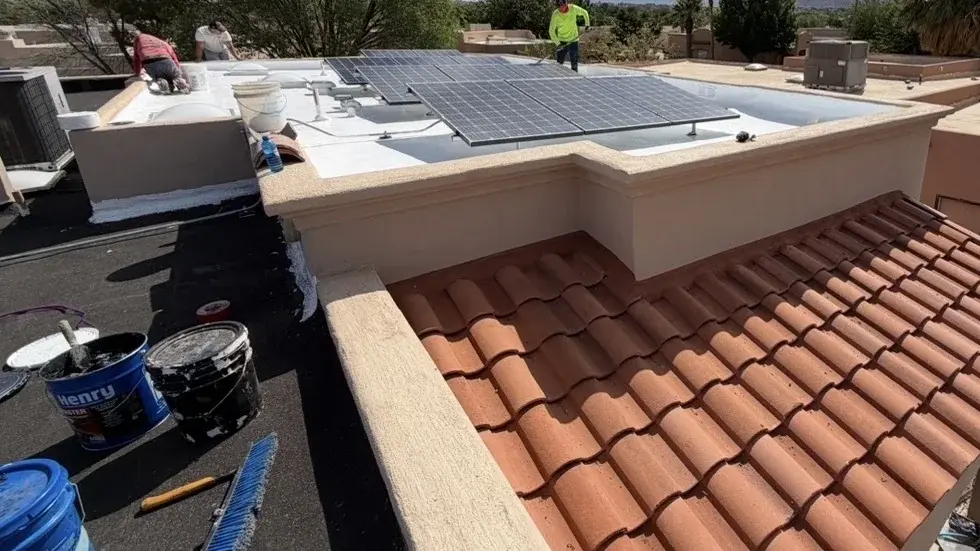
Parapet walls, HVAC curbs, pipe penetrations, drains and scuppers all get custom flashing. On a stucco building, the membrane runs up the inside of the parapet and terminates under a cap or counterflashing. This is the detail that separates a 25-year roof from a 10-year roof, and it's the reason TPO belongs on the roof installation list rather than the DIY list.
How Long Does TPO Roofing Last?
Most sources put TPO roofing lifespan between 15 and 30 years. Interlock Roofing lists installation quality, membrane thickness, climate exposure, maintenance, foot traffic and UV radiation as the variables that decide where in that range a given roof lands.
Thickness is a bigger deal than most people realize. Noble Roofing cites industry data showing 80 mil systems reaching 35 to 40 years under good conditions, compared with 25 to 30 years for 60 mil. A 45 mil membrane is the budget option and it shows in longevity.
Climate cuts the other way. The same source notes that roofs in the desert Southwest see higher surface temperatures and faster oxidation than roofs in milder regions. WeatherShield Roofers makes the same point: extreme heat and heavy UV exposure shorten the range, and poorly welded seams can fail in as little as five to ten years regardless of thickness.
For a Las Cruces flat roof, the realistic expectation is 20 to 25 years for a well-installed 60 mil TPO system, with 80 mil worth the upgrade on buildings with rooftop HVAC traffic or full sun exposure.
Why Does TPO Work Well in Hot Climates?
This is the heart of the "what is TPO roofing" question for anyone in New Mexico, because the material was practically designed for our conditions.
The white membrane is highly reflective. Angi reports that TPO can keep a roof surface up to 50 degrees cooler than conventional dark roofing, which directly lowers the cooling load on the building underneath. On a commercial building running air conditioning from May through October, that's a real line item.
Moser Roofing adds that TPO membranes have excellent UV resistance and reflectivity compared with other single-ply options, which is why they're favored in warmer regions. Modern formulations include UV stabilizer packages that hold up far better than the early TPO products from the 1990s.
There's also the flexibility factor. Las Cruces can swing 40 degrees between a summer afternoon and the following night. TPO expands and contracts with that cycle without cracking, provided the seams and flashings were done right.
TPO vs EPDM vs PVC: How Do They Compare?
TPO roofing is one of three common single-ply membranes, and the differences matter when you're comparing quotes.
- EPDM is a black synthetic rubber. It's flexible, well proven, and often less expensive, but its dark surface absorbs heat, and its seams are taped or glued rather than welded. Angi notes TPO holds up better than EPDM in hot climates.
- PVC is a welded thermoplastic like TPO, with strong chemical resistance and excellent cold-weather flexibility. It typically costs more than TPO and contains plasticizers that can leach over time.
- TPO sits in the middle on cost, matches PVC on welded-seam performance, and beats EPDM on reflectivity. For a hot, dry, high-UV climate, it's usually the strongest value.
If your building has a rooftop restaurant exhaust or chemical exposure, PVC may be worth the premium. For most homes and commercial buildings in Doña Ana County, TPO wins.
What Are the Downsides of TPO?
No honest answer to what TPO roofing is would skip the drawbacks.
Puncture risk. TPO can be punctured by dropped tools, sharp debris and heavy foot traffic. Walk pads around HVAC units and a policy of keeping service technicians on designated paths solve most of this.
Seam dependence. The welded seam is TPO's greatest strength and its biggest vulnerability. A bad weld doesn't show up on day one. It shows up three winters later. This is an installer problem, not a material problem, but it means the crew matters more than the brand.
Ponding water. TPO handles brief standing water, but persistent ponding on a poorly sloped roof accelerates wear and stresses seams. Proper drainage design, with working scuppers and canales, is part of a good installation.
Limited color options. TPO is white, gray or tan. If a specific color matters, you'll be looking at coatings or a different system.
Maintaining and Restoring a TPO Roof
TPO is low-maintenance, not no-maintenance. A twice-yearly inspection, ideally before and after monsoon season, catches seam separation, flashing pull-away and punctures while they're still small repairs. Keeping drains clear and debris off the surface prevents most premature failures. A structured roof maintenance plan is the difference between a 20-year roof and a 30-year roof.
Aging TPO also has a second life. When the membrane starts to chalk or the seams show wear but the roof is still structurally sound, a silicone coating can extend its life by a decade or more. Nationwide Coatings notes silicone lasts 10 to 20 years and handles ponding water well, which makes it the right match for flat TPO roofs. A silicone roof restoration over existing TPO costs far less than a tear-off and keeps the reflective benefits intact.
The Bottom Line on TPO Roofing
So, what is TPO roofing? A white, heat-welded, single-ply membrane that reflects sun, flexes with temperature swings, and lasts 20 to 30 years when it's installed by a crew that knows how to weld a seam. Three takeaways:
- TPO's reflectivity and UV resistance make it one of the best flat roof choices for southern New Mexico's heat.
- Membrane thickness and seam quality decide lifespan far more than brand. Ask what mil you're getting and who's doing the welding.
- Twice-yearly inspections and a silicone restoration at the right time can push a TPO roof well past its expected life.
Contact Gilbert & Sons Roofing and Stucco
Gilbert & Sons Roofing and Stucco is a licensed, insured and bonded contractor serving Las Cruces and Doña Ana County since 2010. We install TPO and other flat roof systems on homes and commercial buildings, and we restore aging TPO with silicone coatings when a tear-off isn't needed. For a quote on a new flat roof, a repair, or a restoration of the TPO you already have, call 575-649-2316, email gilbertandsons2010@gmail.com, or request an estimate through our contact page and we'll come out, look at the property in person, and give you an honest recommendation and a clear quote.