
Blog · Commercial Roofing
How Long Does a Flat Roof Last? Lifespan by Type in Las Cruces
Most flat roofs last 15 to 30 years, but here the membrane rarely gives out first. Flat roofs in Las Cruces fail at the parapets, the drains and the seams.
Contents
Most flat roofs last 15 to 30 years, depending on the membrane, how it was installed and how well it's maintained. In Las Cruces, the membrane itself usually isn't what gives out first. Flat roofs here tend to fail at the parapets, the drains and the seams long before the field of the roof wears through.
That's an important distinction, because it changes what you do about it. A 15-year-old flat roof with a sound membrane and a cracked parapet cap doesn't need replacing. It needs a repair at the edge. A 15-year-old roof with open seams across the whole surface is a different conversation.
This guide answers how long a flat roof lasts by type, explains why flat roofs wear differently from pitched roofs, covers what our climate does to them, lists the signs a flat roof is near the end, and walks through the repair, restore or replace decision.
How Long Does a Flat Roof Last by Type?
Realistic ranges for a well-installed, reasonably maintained flat roof in southern New Mexico:
| Flat roof system | Typical lifespan | Notes |
|---|---|---|
| TPO | 20 to 25 years (60 mil), longer for 80 mil | The white surface handles our sun well, and seam welding quality decides most of its lifespan |
| PVC | 20 to 30 years | Similar to TPO with better chemical resistance, which makes it the pick under restaurant exhaust |
| EPDM | 20 to 25 years | Durable rubber, but the black surface absorbs heat and its seams are taped rather than welded |
| Modified bitumen | 15 to 20 years | Common on older commercial buildings. Holds up to foot traffic, but the asphalt ages under UV unless coated |
| Built-up (tar and gravel) | 15 to 25 years | Multiple layers make it forgiving, but it's heavy and leaks are hard to trace through the layers |
| Spray polyurethane foam | 20 to 30 years or more | As long as the protective coating on top is renewed on schedule. The foam breaks down quickly if the coating fails |
| Silicone-coated roofs | 10 to 20 years per application | The clock resets with each recoat. A sound roof under a maintained coating can keep going for decades |
The spread inside each range comes down to three things: how well it was installed, how well water drains off it, and whether anyone looks at it between leaks.
Why Flat Roofs Wear Differently From Pitched Roofs
A pitched roof sheds water in seconds. A flat roof, which is really a low-slope roof with a quarter inch or so of fall per foot, moves water slowly. That one difference explains most of how a flat roof ages.
Seams carry a constant load. On a pitched roof, water runs over laps and away. On a flat roof, water sits against seams after every storm. A seam that's 90 percent welded will hold on a slope and leak on a flat roof.
Ponding speeds up wear. Anywhere water stands for more than 48 hours, the membrane oxidizes faster, debris collects and the deck underneath takes extra load. A roof with ponding areas ages unevenly, with the low spots failing years ahead of the rest.
Foot traffic is part of the design. Rooftop HVAC units, evaporative coolers, solar arrays and the technicians who service them all live on flat roofs. Every service visit is a chance for a dropped tool or a dragged hose to puncture the membrane.
Every edge is a wall. Most flat roofs here sit behind parapets, so the perimeter isn't a drip edge, it's a vertical termination where membrane, flashing, stucco and a cap all meet. That makes parapet repair one of the most common flat roof services in the region.
How New Mexico Climate Affects Flat Roof Lifespan
When people ask how long a flat roof lasts in Las Cruces specifically, the honest answer is the middle of the national range, sometimes lower, unless the roof is coated or reflective.
UV oxidation. Sun at our elevation breaks down exposed membranes year-round. Asphalt-based roofs (modified bitumen and built-up) dry out, crack and lose granules. Single-ply membranes chalk and thin.
Thermal cycling. A 40-degree swing between afternoon and night is normal. Every cycle stretches and relaxes the membrane, working at seams, fasteners and the transitions at parapets and curbs. Over a decade, that's thousands of cycles.
Monsoon downbursts. Summer storms bring 50 to 70 mph winds that lift membrane edges and drive rain sideways into parapet caps and counterflashing. A roof that's sound in May can have a lifted corner by August.
Dust and drainage. A dry season's worth of dust washes into scuppers and canales in the first big storm. Blocked drains mean ponding, and ponding finds every weak seam within reach.
What helps. Dry air means no moss, no algae and very little freeze-thaw damage. A reflective membrane or coating also cuts heat load dramatically, which is why TPO and silicone-coated roofs tend to outlast dark asphalt roofs here.
What Shortens a Flat Roof's Life
The biggest factors, roughly in order:
- Ponding water from poor slope, a deflected deck or blocked drains
- Parapet failures that let water in at the top of the wall and behind the membrane
- Clogged scuppers and canales after dust storms and the first monsoon rains
- Poor seam welding or adhesion at installation, which shows up three to five years later
- Rooftop equipment traffic without walk pads
- Skipped maintenance, where small seam lifts and sealant failures go unaddressed for years
Signs Your Flat Roof Is Near the End
- Blisters across the membrane, especially on modified bitumen and built-up roofs
- Alligatoring, a cracked pattern on asphalt-based surfaces that means the material has dried out
- Open or lifting seams in multiple areas, not just one spot
- Soft spots underfoot, which point to wet insulation or a damaged deck below
- Membrane shrinkage pulling away from parapets and curbs
- Recurring leaks in different locations after repairs
- Visible deck sag or ponding areas that are growing each year
- Chalking, thinning or exposed scrim on single-ply membranes
One or two of these in one area is a repair. Several of them spread across the roof on a system past 15 years is a sign the roof is near replacement, or at least due for a moisture survey before anything else is decided.
How to Extend a Flat Roof's Life
The good news about how long a flat roof lasts is that maintenance moves the number more on flat roofs than on any other roof type.
- Inspect twice a year, before monsoon season and after it. A roof maintenance plan puts this on a schedule.
- Clear every scupper, canale and drain in spring and again after the first big storm.
- Install walk pads around HVAC units and along service paths.
- Fix seam lifts and parapet cracks immediately. On a flat roof, a small opening becomes a large wet area fast because water travels between the membrane and the deck.
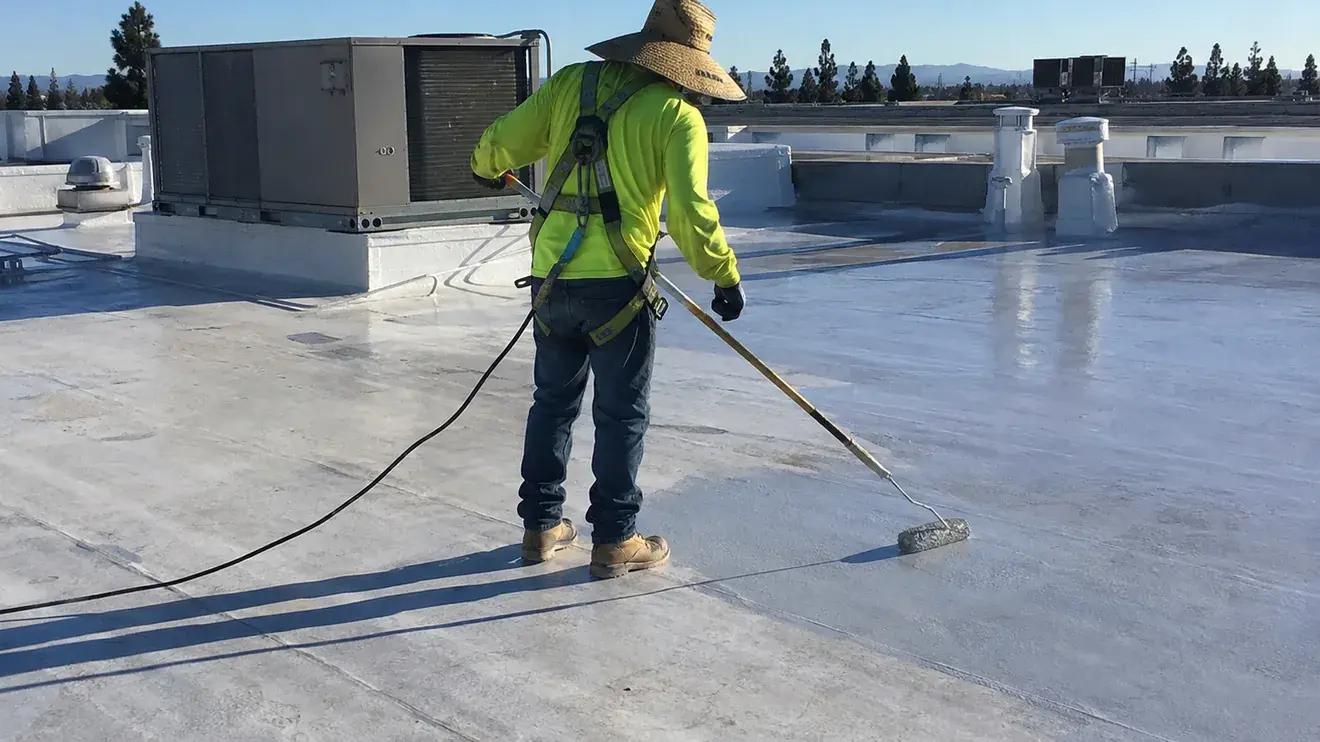
- Coat before the membrane fails. A silicone coating applied while the membrane is still sound adds 10 to 20 years and resets the clock. See how long roof coating lasts for lifespan by coating type.
- Address ponding at the source. Clearing drains, adding a drain, or installing tapered insulation in low spots.
Repair, Restore or Replace?
Three questions decide it.
Is the insulation dry? A moisture survey (infrared or nuclear meter) maps any wet areas under the membrane. If wet insulation covers only small areas, those sections are cut out and replaced, and the rest of the roof can be repaired or restored. If it's widespread, roughly a quarter of the roof or more, replacement is usually the honest answer.
Is the damage local or system-wide? One open seam or a failed parapet termination is a roof repair. Open seams, blisters and shrinkage across the whole roof point to a system at the end of its life.
Is the deck sound? If the deck is solid and the insulation is dry, a silicone roof restoration can add decades at a fraction of replacement cost. If the deck is compromised, a roof replacement is the fix.
Most flat roofs in Las Cruces that are 12 to 20 years old fall into the restore category. That's worth knowing before you get a replacement quote. For a closer look at the most common membrane here, see what TPO roofing is.
The Bottom Line on Flat Roof Lifespan
So, how long does a flat roof last? Fifteen to 30 years depending on the type, with TPO, PVC and coated roofs at the longer end in our climate and asphalt-based roofs at the shorter end unless they're coated. Three takeaways:
- Flat roofs in Las Cruces usually fail at parapets, drains and seams first. Fixing those details is often all a mid-life roof needs.
- Ponding water is the single biggest lifespan killer. Keep drains clear and fix low spots.
- A silicone coating applied while the roof is still sound can push it decades past its expected life. A moisture survey tells you whether yours qualifies.
Contact Gilbert & Sons Roofing and Stucco
Gilbert & Sons Roofing and Stucco is a licensed, insured and bonded contractor serving Las Cruces and Doña Ana County since 2010. We repair, restore and replace TPO, modified bitumen, built-up and coated flat roofs, including the specialty roofing systems and stucco parapets most roofers leave to someone else. To find out how much life your flat roof has left, call 575-649-2316, email gilbertandsons2010@gmail.com, or request an estimate through our contact page and we'll inspect it, check for moisture and give you an honest recommendation.