
Blog · Roofing
What Is Roof Flashing? Types, Where It Goes and Why It Leaks
Roof flashing is the metal or membrane at every break in the roof that sends water back onto the roof instead of into the building. Here are the types, where each one goes on a stucco home, and why flashing is the top leak source.
Contents
Roof flashing is thin sheet metal, or on flat roofs a strip of membrane, installed wherever the roof surface is interrupted or meets something vertical: a wall, a chimney, a pipe, a skylight, a parapet. Its job is to catch water at those breaks and send it back onto the roof instead of into the building.
That's the whole definition. Here's why it matters more than the definition suggests. Ask any roofer in Las Cruces where leaks come from and flashing is the first answer, ahead of the shingles, the tiles or the membrane. The roofing material covers the big open areas where water shedding is easy. Flashing handles every place where it's hard, and every one of those places is a seam between two materials that move differently in the heat.
This guide explains what roof flashing is made of, walks through each type and where it goes, shows where it lives on a typical stucco home, covers why it fails, and lays out how to know when yours needs work.
What Is Roof Flashing and What Does It Do?
Flashing works on two principles: overlap and gravity. Each piece is layered so that water running downhill always lands on top of the next piece, never behind it. Sealant is a backup, not the primary defense. A flashing detail that depends entirely on caulk to stay dry is a detail that will leak once the caulk dries out.
Materials. Galvanized steel is the standard on residential roofs because it's affordable and durable. Aluminum is lighter and easier to bend but corrodes on contact with wet concrete or stucco, which matters here. Copper is the premium choice and lasts the life of the building. On flat roofs with TPO or PVC membranes, flashing is often the membrane itself run up the wall, plus TPO-clad metal at edges and terminations so the membrane can be heat-welded to it.
Where it sits in the system. On a pitched roof, flashing goes on after the underlayment and before or between courses of roofing so it's woven into the layers. On a flat roof, base flashing turns the membrane up the wall and counterflashing or a cap covers the top edge. Either way, flashing is integrated into the roof, not laid on top of it.
The Types of Roof Flashing
Each type solves a specific geometry problem.
Step Flashing
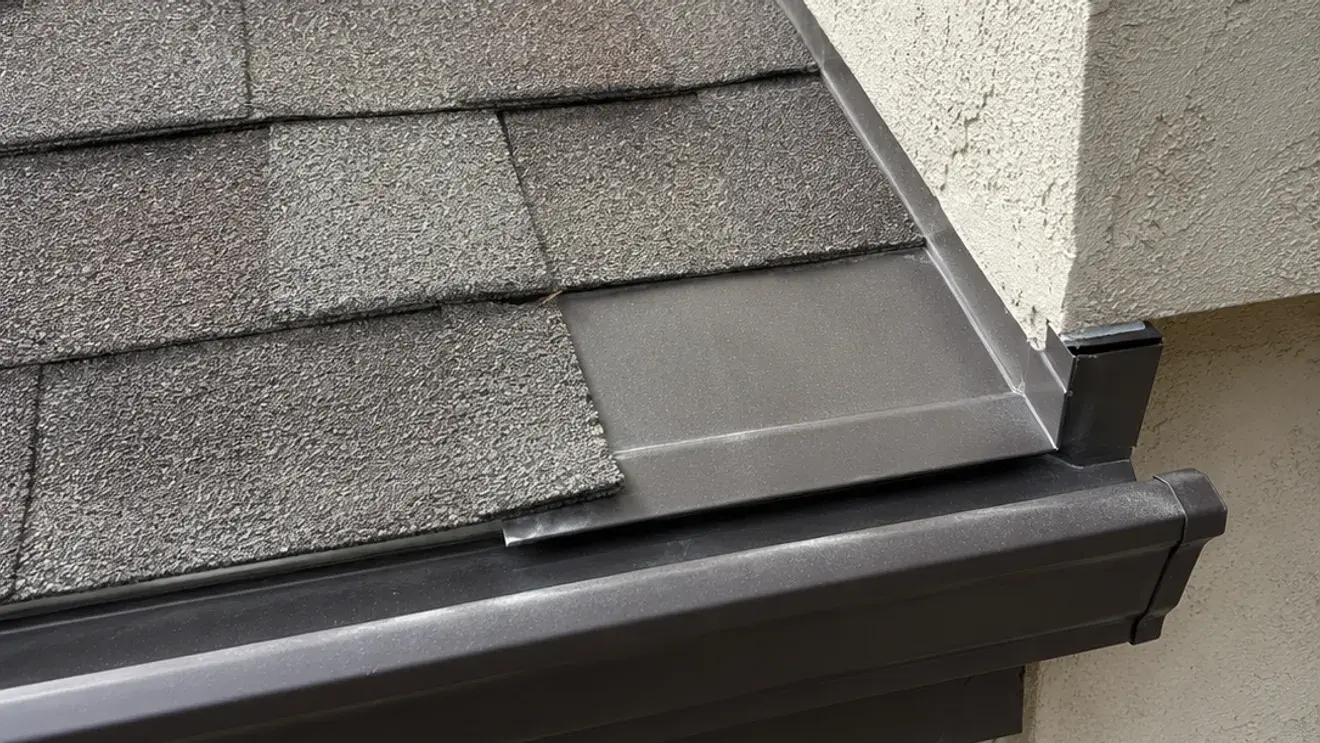
L-shaped pieces installed one per course where a pitched roof meets a vertical wall. Each piece laps over the shingle below and under the shingle above, stepping up the wall. This is the workhorse on shingle and tile roofs against stucco walls and chimneys.
Counterflashing
A second layer that covers the top edge of step or base flashing, tucked into the wall or under a cap so water can't get behind the first layer. On stucco, counterflashing is either embedded in the stucco or set into a reglet cut into the wall.
Continuous or Apron Flashing
One long piece along the base of a wall or the front of a chimney where the roof runs straight into it. Includes expansion joints on long runs so thermal movement doesn't buckle it.
Kickout Flashing
A small angled piece at the bottom of a step-flashing run that diverts water away from the wall and into the gutter. Without it, water runs straight down the wall face behind the stucco. Missing kickout flashing is one of the most common causes of stucco rot below a roofline, and it's a detail many older homes in the region never got.
Drip Edge
Metal along the eaves and rakes that carries water off the roof edge and past the fascia. It also keeps wind-driven rain from getting under the first course of roofing.
Valley Flashing
Metal in the channel where two roof planes meet. Valleys carry the most concentrated water flow on the roof, so this piece takes the most abuse.
Vent Pipe Boots
A flanged base with a rubber or metal collar that seals around plumbing vents. The rubber collar is usually the first thing on any roof to fail in New Mexico sun.
Chimney and Skylight Flashing
A combination of apron, step, counterflashing and a cricket (a small peaked diverter) behind the chimney to keep water from pooling against the back.
Parapet and Base Flashing on Flat Roofs
On flat roofs, the membrane turns up the inside of the parapet wall as base flashing and terminates under a cap or counterflashing. Scuppers and canales that drain through the parapet each get their own flashing sleeve.
Where Flashing Goes on a New Mexico Home
Stucco homes have more flashing transitions than most, and a few of them are unique to this region.
- Stucco wall intersections. Every place a lower roof dies into a second-story wall needs step flashing, counterflashing and kickout flashing integrated with the weep screed at the base of the stucco.
- Parapets. On flat-roofed Pueblo and commercial buildings, the parapet is the single biggest flashing detail on the property. Cap, counterflashing and base flashing all meet there. Our guide to parapet repair covers that detail in depth.
- Canales and scuppers. Each drain through a parapet is a hole in the wall that needs a flashed sleeve tied into the membrane.
- Tile-to-wall transitions. Tile roofs need pan flashing under the tile at walls, with the tile cut around it, since tile can't be woven with step flashing the way shingles can.
- HVAC curbs and penetrations on flat roofs. Every rooftop unit sits on a curb that needs flashed corners and a counterflashed top.
- Chimneys. Common on older adobe and territorial-style homes, and often flashed with nothing but a bead of caulk.
Understanding what roof flashing is on a stucco home comes down to understanding that most of these details are shared between the roofer and the stucco crew. Get one side right and the other wrong, and it still leaks.
Why Does Roof Flashing Fail?
Flashing outlasts most roofing materials when it's installed well. When it fails, the cause is usually one of these.
Thermal cycling. Daily temperature swings of 30 to 40 degrees expand and contract metal against stucco, wood and membrane. Over years, that works fasteners loose and opens gaps at laps.
Sealant breakdown. UV at our elevation bakes caulk and sealant hard within a few seasons. Any flashing detail that relied on sealant alone starts leaking when it does.
Stucco applied over the flashing edge. This is the big one locally. When stucco is troweled down over the top edge of step or apron flashing instead of stopping above it, water wicks behind the stucco and runs down inside the wall. The roof looks fine. The wall rots.
Missing kickout flashing. Water runs down the wall face, behind the stucco, and shows up as staining and soft spots at the base of the wall years later.
Rust and corrosion. Galvanized coating wears through, or aluminum sits against wet stucco and corrodes.
Bad original installation. Reused old flashing on a re-roof, flashing face-nailed and caulked instead of lapped, or no counterflashing at all.
Signs Your Roof Flashing Needs Repair
- Ceiling stains along an exterior wall or below a chimney, skylight or vent
- Rust streaks running down the roof or the stucco below a transition
- Lifted, bent or separated metal visible from the ground at wall lines or the roof edge
- Cracked or missing sealant at counterflashing and pipe boots
- Dark stains or efflorescence on stucco just below where a roof meets the wall
- Soft or hollow stucco at the base of a wall below a roofline, which points to a missing kickout
- Water at the parapet's inside face on a flat roof
A stain at a wall line with intact roofing above it is almost always a flashing problem, not a roofing problem. A professional roof inspection will check every transition rather than just the field of the roof.
Flashing Repair vs Replacement
Resealing is appropriate when the metal is sound and properly lapped but the sealant at counterflashing or a pipe boot has dried out. It's quick and it buys years.
Replacement is the answer when the metal is rusted through, was never lapped correctly, is missing kickout pieces, or has stucco run over the top of it. That last case means opening the stucco, installing the flashing correctly with the paper and weep screed, and re-stuccoing the wall. It's more work, but it's the only fix that holds. A roof repair that reseals over bad flashing is a repeat call in two years.
On a full re-roof, all flashing should be replaced. Reusing old flashing on a new roof installation is the single most common shortcut that shortens a roof's life.
How Flashing Ties Into Stucco
This is the part most articles about what roof flashing is skip, and it's the part that matters most here.
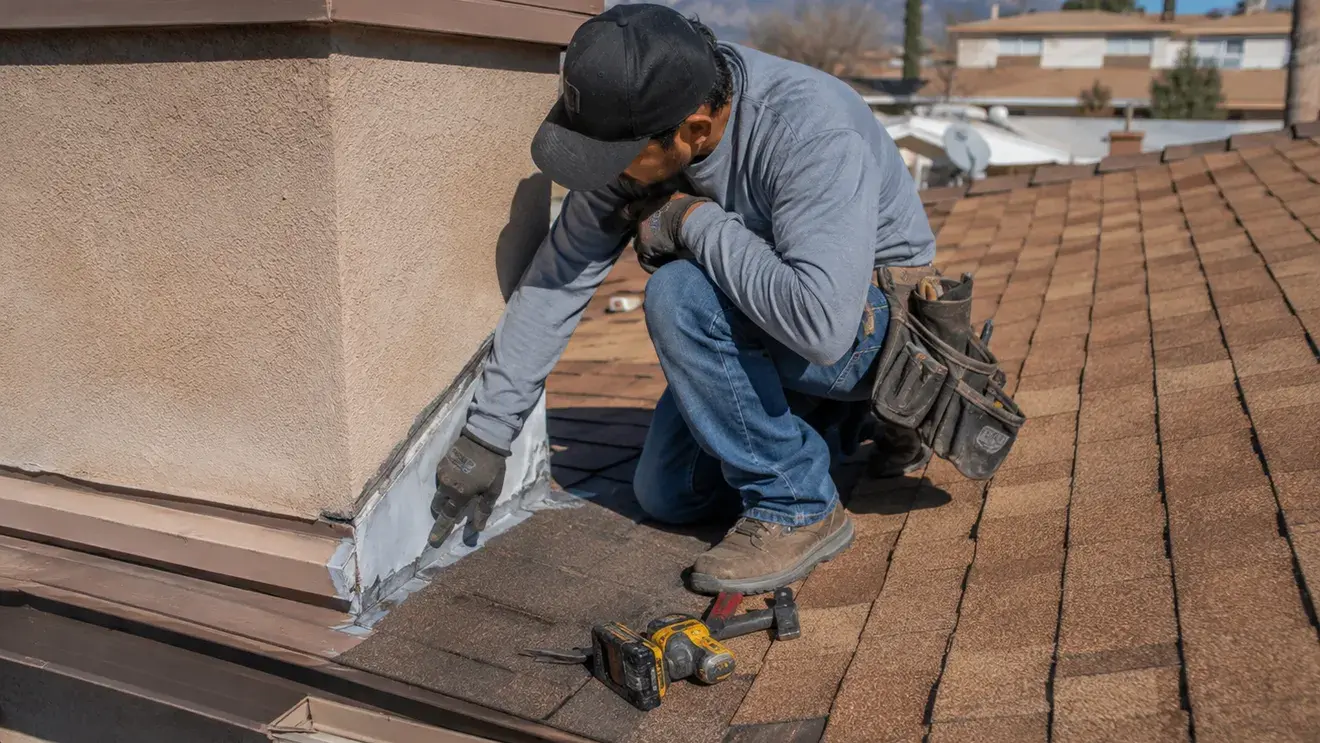
On a framed stucco wall, the flashing at a roof-to-wall transition has to be layered with the weather-resistive paper behind the stucco, the weep screed at the base, and the stucco itself. The step flashing goes on. The paper laps over it. The stucco stops above the flashing with a casing bead, not over it. The kickout at the bottom diverts water clear of the wall.
Get that sequence right and the wall stays dry for decades. Get it wrong, or let a roofer and a stucco crew each do their half without talking, and water finds the gap. This is why stucco work and roofing are the same trade on this kind of building. For the wider picture, see our guide to stucco roofing.
The Bottom Line on Roof Flashing
So, what is roof flashing? The metal and membrane at every break in the roof that directs water back where it belongs. Three takeaways:
- Flashing is the number one leak source on most roofs. When a leak appears at a wall, chimney or penetration, look at the flashing before the roofing.
- Flashing works by overlap, not sealant. Any detail that depends on caulk will fail once New Mexico sun dries it out.
- On a stucco home, flashing and stucco are one system. Stucco run over the flashing edge and missing kickout flashing are the two most common local causes of wall damage.
Want to know how a roofer checks every one of these details? Our guide to what a roof inspection includes walks through the full checklist.
Contact Gilbert & Sons Roofing and Stucco
Gilbert & Sons Roofing and Stucco is a licensed, insured and bonded contractor serving Las Cruces and Doña Ana County since 2010. Because we do both roofing and stucco, we handle flashing transitions from the roof side and the wall side in one visit, including parapets, roof-to-wall intersections and kickout retrofits. If you've got a stain at a wall line or rust streaks on the stucco, call 575-649-2316, email gilbertandsons2010@gmail.com, or request an estimate through our contact page and we'll inspect every transition on the roof.